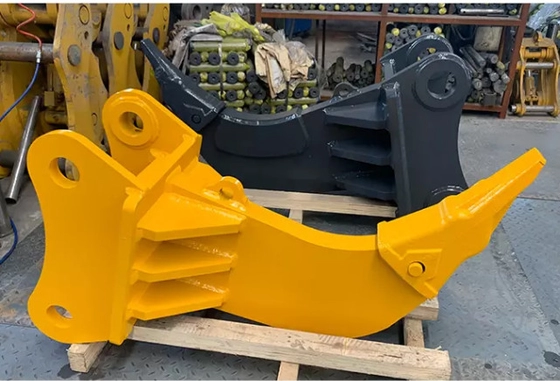
The construction, mining, and earthmoving sectors face mounting pressure to cut carbon emissions and reduce operating costs. One often-overlooked lever for sustainability is equipment efficiency at the attachment level — and in particular, the Excavator Single Shank Ripper. When specified, maintained, and used correctly, a high-performance ripper can lower fuel consumption, shorten project timelines, and extend machine life — all of which add up to measurable environmental and economic benefits.
People tend to evaluate fuel efficiency by looking at engines, hybrid systems, or alternative fuels. Those are critical, but the interaction between the excavator and the ground is where the rubber (or ripper) meets the road. Poorly matched attachments force machines to work harder — longer idling, excessive cycles, or additional passes — which increases fuel burn and wear. An Excavator Single Shank Ripper changes the equation: it breaks up compacted soil, frozen ground, and rock seams ahead of the bucket, reducing the effort required for subsequent digging and loading.
Pre-conditioning the ground — Ripping fractures the material, so the bucket must do less shear and crushing. That translates into fewer hydraulic cycles and less engine load per cubic metre moved.
Fewer machine passes — Effective ripping lowers the number of passes needed to prepare a working face, which reduces travel time, idling, and repositioning energy.
Improved cycle efficiency — When the excavator isn’t straining to tear material free, hydraulic systems operate in more efficient load ranges and the engine runs at steadier, more efficient RPMs.
Reduced auxiliary equipment use — Tasks that otherwise require additional breaker units, dozers, or manual interventions can often be eliminated or minimized when a ripper is used appropriately.
Faster project completion — Less time on-site means lower cumulative fuel consumption across the fleet and a smaller project carbon footprint.
Not all rippers are equal. To maximize sustainability gains, select a ripper that matches the material and the host machine:
Shank geometry: A curved, tapered shank penetrates and transfers force more efficiently in certain soils; straight shanks can be better for ripping through broken rock.
Tip design and material: High-wear, carbide-tipped points last longer and maintain penetration ability. Longer life reduces replacement frequency and the environmental impact of spare parts.
Mounting compatibility: A ripper designed for the excavator’s linkage and hydraulic/pin configuration preserves machine balance and reduces unintended stresses that waste fuel.
Adjustability: Rippers with adjustable angles or replaceable segments adapt to different job conditions, which increases utility and reduces the need for multiple attachments.
Sustainability gains from a ripper are only as good as the upkeep:
Regular inspections: Worn tips or bent shanks lower ripping efficiency and increase fuel draw. Inspect before each shift.
Timely tip replacement: Replacing a worn tip keeps penetration performance high; delaying replacement forces the machine to work harder.
Greasing and fastener checks: Loose or dry joints reduce force transfer and cause inefficient operation.
Proper storage and corrosion control: Longer-lived attachments need fewer replacements — fewer parts manufactured, transported, and disposed of.
Use ripping as a pre-step: Plan ripping passes before bulk excavation to maximize the benefit.
Match ripping depth to material: Too shallow yields little benefit; too deep stresses the machine. Find the sweet spot through test ripping.
Train operators: Skilled operators can choose the correct speed, angle, and pass pattern to get the most out of the ripper while minimizing fuel. Operator technique often accounts for a large share of efficiency improvements.
Monitor fuel and productivity: Track fuel use per tonne or per cubic metre moved before and after deploying the ripper to quantify benefits and refine practice.
An Excavator Single Shank Ripper that’s designed for durability and rebuildability contributes to circularity. Replaceable tips and refurbishable shanks reduce raw-material demand and waste. Buying attachments with remanufacturing or recycling programs further lowers a project’s embodied carbon.
Exact fuel savings depend on soil type, machine class, and operational discipline, but typical on-site reports show:
Reduced fuel consumption per cubic metre moved when ripping precedes excavation.
Lower total machine hours for site preparation phases.
Fewer auxiliary tools needed (breakers, additional dozers), shrinking both emissions and costs.
Even modest percentage reductions in fuel use compound across fleets and projects, delivering meaningful reductions in CO₂ emissions and operating expenses.
Sustainability in heavy equipment is multi-dimensional. Engine upgrades, electrification, and alternative fuels are vital longer-term shifts, but immediate gains are available now: smarter attachment choices and smarter use of those attachments. The Excavator Single Shank Ripper exemplifies this — a relatively low-cost component that, when chosen and used correctly, reduces fuel use, shortens project duration, and extends equipment life. For contractors and fleet managers looking for practical, immediate sustainability wins, ripping is a powerful, underused tool.