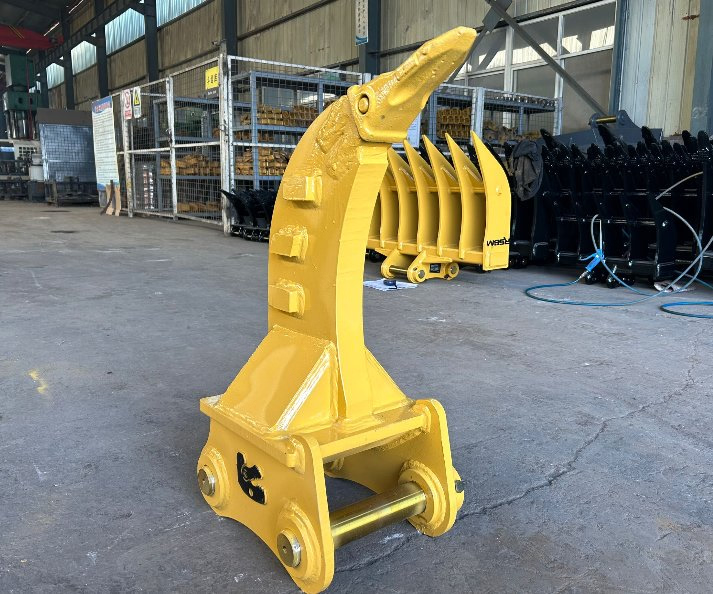
Excavation technology has come a long way from simple manual digging tools to today’s highly engineered attachments designed for maximum efficiency. Among these attachments, the Excavator Single Shank Ripper stands out as a powerful tool that has significantly transformed earthmoving, demolition, and mining operations. Its journey from a basic ripper tooth to a precision-built, heavy-duty attachment showcases how innovation continues to shape the construction and mining industries.
Before mechanized equipment existed, ground-breaking tasks depended entirely on manual labor. Workers used picks, chisels, crowbars, and iron bars to break through compact soil and rock layers. While these tools provided basic functionality, they were slow, labor-intensive, and far from ideal for large-scale projects.
The introduction of early industrial machines in the late 19th and early 20th centuries opened the door for the first mechanized rippers. These early rippers were rudimentary attachments added to tractors and early excavators, primarily used to break hard soil or frost. Though basic in design, they laid the foundation for the modern ripper attachments we rely on today.
As construction projects grew in scale—particularly with the rise of highways, mining operations, and large-scale infrastructure—the need for efficient ground-breaking equipment became even more crucial. Mechanical rippers evolved with improvements in hydraulics, metallurgy, and machine power.
By the mid-20th century, excavators had grown stronger and more versatile, enabling the development of specialized ripping attachments. The ripper transformed from a simple hook-like tooth into a more advanced tool capable of tearing through compacted soil, decomposed rock, asphalt, and even frozen ground.
This era marked the beginning of attachments engineered specifically for performance, durability, and machine compatibility.
Modern rippers are not just about brute force—they are engineered for precision, control, and maximum penetration power. The Excavator Single Shank Ripper in particular has become an indispensable tool across industries such as:
Mining and quarrying
Road construction
Demolition
Agriculture and land development
Pipeline and utility trenching
Its evolution reflects advancements in design, materials, and manufacturing.
Today’s Excavator Single Shank Ripper is far more sophisticated than earlier versions. Precision engineering and advanced materials have enabled it to perform even in the harshest environments.
The shank is designed to deliver maximum force at the point, allowing operators to cut through rock, shale, or frozen soil easily. The curvature, angle, and tooth design ensure wider and deeper penetration with minimal machine strain.
Modern rippers use abrasion-resistant steel, high-tensile alloys, and heat-treated tips. This dramatically enhances wear life and ensures the attachment can withstand continuous heavy-duty use.
Earlier rippers required full replacement when worn out. Modern units feature replaceable teeth, side cutters, and reinforced shank guards—reducing downtime and maintenance costs.
Manufacturers now produce rippers compatible with excavators ranging from 5 tons to over 50 tons. This versatility makes the Excavator Single Shank Ripper a highly practical choice for contractors of all scales.
Thanks to hydraulic improvements and ergonomic machine controls, operators can achieve higher precision and better breakout force with much less machine effort than before.
The demand for single shank rippers has grown significantly due to increasing infrastructure development and mining activities. These attachments help reduce operational costs by minimizing the need for blasting or high-energy tools. In agriculture, farmers use them to break hard clay or roots before soil preparation.
In mining, they are invaluable for reducing blasting requirements—making operations safer, quieter, and more environmentally friendly.
The evolution of rippers is far from over. With advancements in robotics, smart machinery, and automated excavators, we may soon see ripper attachments integrated with sensors that monitor:
Ground hardness
Wear rate
Operator efficiency
Real-time stress loads on the attachment
Future Excavator Single Shank Ripper models may include stronger composite materials, AI-assisted digging modes, and optimized designs created with 3D simulation technologies.
From crude hand tools to today’s precision-engineered attachments, the journey of rippers reflects the broader evolution of construction and mining equipment. The Excavator Single Shank Ripper represents the peak of this evolution—combining strength, precision, and durability to handle the toughest ground-breaking challenges.
As technology continues to advance, the ripper will only become more powerful, efficient, and intelligent, ensuring its place as a critical attachment for modern excavation projects.